Disclaimer: This website is not an official U.S. Department of State website. The views and information presented are the grantee’s own and do not represent the Teachers for Global Classrooms Program, IREX or the U.S. Department of State.


Tuesday, July 2, 2013

Powerful Mother Nature

Today I had the chance to see something that is nothing like I have ever seen before!  Foz do Iguacu (or better known to us in the states as Iguacu Falls) is a series of 275 waterfalls between Brazil and Argentina, that show us how powerful Mother Nature is!  Walking out on the walkway towards the waterfalls with the mist so strong one becomes instantly drenched, but worth very moment.  As we approached today a rainbow was emerging, and as we went further down the path it became brighter and larger and eventually we saw a complete rainbow!  Each time I saw a new part of the falls, it seemed better than the first!  This day will not be forgotten!  

Due to recent rains, the falls have ten times the amount of water they normally have, causing Devil's Throat (the largest series of falls on the Argentina side) pathway over the fall to be closed for safety.  

I took over 200 pictures today ( don't worry I will not attach them all or make you watch a slide show- unless you want too!) plus videos!  I will try and attach videos at a later point, as I cannot upload them on my I-pad.  I am afraid that the pictures and videos will not do the waterfalls justice, nor this blog post!  I feel incredibly grateful for this experience!  


Yes, you do get drenched at the end of the walkway!


So may butterflies!  They were landing on our table (this is a map we had) at lunch, on our shoes (which were off trying to dry out), and even on us!


An actual toucan bird!


At sunset


Saturday, June 29, 2013

Salvador

Salvador, Bahia was settled by the Portuguese in 1549 and is the third largest city in Brazil (Sao Paulo being the largest and Rio de Janeiro the second).  The city has influences from the Portuguese, African heritage, and the indigenous people.  Salvador was the first slave market on the South American Continent.  

The views in the city are incredible!

View from hotel balcony!  The weather is hot and humid here!  It is a beautiful view running by the Atlantic Ocean.

At the hotel pool around sunset

Pelourinho is the historical center of the city.  Suprisingly, as I am looking in one of my guide books, discovered that Pelourinho means "whipping post," but somehow I had not heard this before on our tour of the city or while visiting the area several times in the past few days.  Several of the churches I wrote about a few days ago were also in this area.

Theatre where we watched Bale Folclorico da Bahia, of Bahia performance, which involved music, dances of the Candomble (African religion where music and dance are part of it), and Capoeira.  Capoeira is an African fight that was brought to the country by slaves, they would do this with music as a way of staying fit and being ready to fight their masters.  It was illegal to do as a slave, so they made it appear similar to a dance.

Historical buildings in Pelourinho.

Before the folklore show

Anne, Cynthia and myself at dinner.


In Pelourinho we saw Teacher's brand of whiskey...It grabbed our attention!


Church in the middle of the town square.

City is decorated for the June parties.


Beers being sold for about .50 cents USD in the historical square.  (Not sure if this is only during the June parties or all the time!)

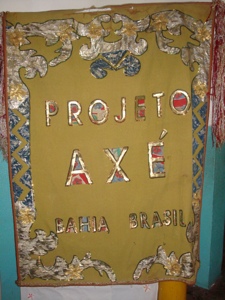
Our group had the privilege of visiting Projeto Axe, in the heart of Pelourinho.  The program helps children stop living on the street by agreeing to go back home or with a family member and attend school, assist the families as needed, and has the children to participate in a visual or performing arts activities.  The students participate in dance, music, art during the session they are not at school and are given two meals daily.  Sometimes these are the only meals the students eat. Over 1,000 children and families benefit yearly from the program.


Students from Projeto Axe.

Art project students created.

Forte de Santo Antonio, a light house built in 1535, then strengthened again in the early 17th century to help defend the city from the Dutch.

Behind the lighthouse.


View of the Mercado Modelo (the large building in front), built in 1861 as a customs building and slave trade building.  Now it is used as a market for merchants to sell their goods and souvenirs.  Off to the left you can see the Elevador Lacerda built in 1873 (yes it has been updated!) connects the lower part of the city to the upper part.  


Sidewalk in Vitoria area


Mosaics on the walls in Vitoria district.

Statue in the middle of a park in Vitoria which is the indigenous people stabbing a snake (which represents the Portuguese).  Statue is beautiful and rather symbolic.

Thursday, June 27, 2013

Good bye to Taguatinga!

The last day in Taguatinga was a day of good bye's and a manifestation (or what we call protests)!  Monday did not go as planned, but I did get to witness a historical event in Taguatinga.  Throughout my time in Brazil the country has been in the middle of various manifestations.  The people in Brazil have decided to stand up for what they believe in.  Many people are upset with the fact that so much money and attention are being diverted to the World Cup, Confederation Cup and soccer in general, when the people would prefer the money is spent on education, health care and public transportation systems.  Additionally, many do not want a current bill PE37 to pass in Congress that would allow politicians who have been found corrupt to not receive a consequence.  This particular manifestation was primarily students.  

Isabelle's students left school around 5:45pm, but we were unable to leave until 8pm or so.  The protesters were walking in the streets and roads were being closed by the police.  At one point there were loud noises inside the staff lounge were we were waiting for traffic to improve.  Outside the protesters were walking in the streets next to the school with the police following.  We were safe inside as the school is surrounded by concrete walls and gates, but then we had to wait longer. Also, near my hotel was lots of traffic and police presence, so I was not being brought there until Isabel and I knew it was safe. 

I am curious to see what happens after the Confederations Cup, will the manifestations continue or will the movement end as soccer no longer is the main focus in the country? 

The Brazil soccer team becomes such a priority that schools will close early and businesses close when the team plays!   Many of the educators my colleagues and I spoke with do not seem interested in soccer and would rather schools not be closed. 

These are photos that appeared on an online news feed, so I can not take credit for them.  
The clock tower square in the middle of Taguatinga near the school. 


Students did organize this protest!

Last night in Salvador a protest was beginning.  One. Of my colleagues, Vicki, took this picture of the police getting ready for the demonstration.


Salvador churches

Today we went around Salvador seeing historical sites!  The cathederals are amazing, so beautiful and elaborate!  Salvador is an incredible place, and will write more about it later.


Igreja De Nosso Senhor Do Bonfim Catholic Church.  Many of the churches here are so beautiful.


This is an active church for worship. 
This church has an ornate ceiling just as so many of them do.

This church is known for those that have an ailment and come to pray.  It is believed that if you pray and buy/obtain a part that represents where your illness is then this will help you heal.  This is a picture of the room with parts.... and note of those who need prayers or have been treated/cured.


Here are the colorful ribbons, fitas, that are frequently tied to people's wrists with 3 knots - each knot represents a wish.  The wishes are granted when the ribbon wears off and falls off the wrist.  It sounds alot like our friendship bracelets! Vendors are standing outside the church selling these ribbons!  Yes, I made some wishes and tied some on the fence. 


Catedral Basilica -  This is a Saint Francis of Assissi church.
 This is the Catedral Basilica built between 1657 and 1672 and has gold leaf covering much of the Baroque architecture inside.

These tiles were all imported from Portugal, and are in the exterior (middle) portion of the church.  The tiles are under a walkway, but this is an open air portion of the church and has been exposed to the weather.  A story is being told as you walk around the tiles.

The interior portion.


Inside the cathederal, very elaborate!  Also a working church for worship and weddings.

This church is related to the Catederal Basilica, but is just down the block.

Tuesday, June 25, 2013

Festa Junina

Festa Junina (June Parties) are common place in schools, primarily elementary age.  The tradition dates back to when the Portuguese colonized Brazil.  Children participate in choreographed dancing where directions are called out, similar to square dancing.  Each dance that I witnessed was between 10 and 15 minutes. Students are dressed in costumes, and there is even a bride and groom for most dances.  The party I attended there were simple games children could play, such as fishing for a toy in the sand using a wooden stick and string, and lots of food in the decorated school gymnasium.  The songs and dances represent various cultures and areas from Brazil.